
 Examining Popular Participation in Scottish Politics by Maike Dinger
We are continuing our media book club series with our next contributor Maike Dinger. In this blog post we ask Maike her experience writing her first academic book: She also provides an account on the challenges of adapting a PhD thesis into a published manuscript alongside sharing some tips on tricks for those looking to begin the process of writing a book proposal.
Maike Dinger is a lecturer in Communications, Media and Culture at the University of Stirling. She has recently completed an interdisciplinary PhD research project which has recently adapted into an academic book. Her research interests links between culture, politics, national identity and participation.
What is your book about?
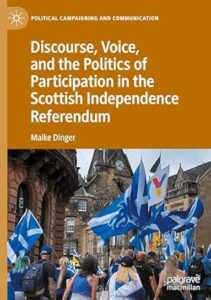
Taking the 2014 Scottish independence referendum as its case study, the book examines popular participation and elite interventions in democratic, plebiscitary events. It addresses how the referendum was constructed, represented, and performed as a participatory moment in media and political discourses and asks how elite representations overlap or contrast with referendum experiences of the public.
On this basis, the book establishes the conditions for a more nuanced evaluation of the consistent under- and misrepresentation of marginalised groups in Scottish politics. The main question the book addresses is what role and opportunities did popular participation—both practical and rhetorical— fulfil in the referendum? In exploring this question, I also consider the following: how was popular participation in the referendum discursively constructed and circulated in Scottish media and political discourse; how do underpinning notions of democratic representation, progressiveness, and cultural identity operate within this myth of popular participation; and what are its political functions, legacy, and potential ramifications?
In response to these questions, the book draws attention to discursive and practical hurdles in addition to more widely acknowledged structural and habitual limitations to political participation. The aim in doing so is twofold. Firstly, to address the Scottish independence referendum in its national situatedness and to analyse it in its specific cultural and socio-political context, including celebrations of Scottish exceptionalism. In doing so, the book adds to an understanding of how political practice and narratives of Scottish exceptionalism have established the conditions for the independence referendum and the boundaries of popular participation within it. Secondly, the book considers popular participation in plebiscitary events and deliberative democracies more generally. Through analysis of the mobilising powers of popular participation and the limits thereof, the book addresses wider challenges of political participation and inclusion in the context of grassroots politics, mediatisation, and digital politics. Drawing on a range of methods and a unique primary data set (including interviews, focus groups, newspapers, literature, and social media data), the book raises questions around political apathy and disaffection and identifies various levels of exclusion in political decision-making and hurdles that prevent politics from being participatory and engaging— in Scotland, the UK, and in Western deliberative democracies more generally.
What was your favourite part of the research process?
The book, and the research it is based on, is about stories and people. Like much of my research to date, it focuses on narratives of identity and shared memories, on being heard and seen, on being represented. In keeping with this focus, it was important to me to capture the different stories and narratives that emerged from and revolved around the 2014 Scottish independence referendum as a significant moment in time. I was eager to capture the different stories and experiences tied to this moment. Seeing these stories emerge and listening to.
people’s memories, having them share with me their lived experiences, a part of who they are and how they see the world has always been one of my favourite things about doing research. The downside is that if you do this part of the research process well, you end up wading through huge amounts of fascinating data and trying to organise it can be incredibly laborious, especially if you use multiple methods to capture the diverse stories that shape people, events, and nations. But doing so leads to another favourite part of the research process for me: the feeling when everything falls into place. When all the different strands come together, the jigsaw pieces connect, and the research story and argument find their way onto the page.
Which aspects of the writing process were particularly challenging? Which were the most enjoyable?
The book is informed by research undertaken as part of my PhD project with the University of Stirling and the University of Strathclyde. Therefore, a lot of the argument and the majority of the findings and analyses were written up before I started re-writing, re-ordering and expanding the material for the monograph. That being said, re-organising and re-writing the material felt like a big challenge to start with because it went against the sense of completion I had from finishing the PhD. Thus, the most challenging part of writing the book was re-writing it. It was the process of diving into the text again and tearing some of the onerously crafted chapters apart (slightly!), of rearranging and cutting content. For my book proposal, I needed to outline how I intended to transform the thesis into a monograph, so most of the thinking behind this restructuring was already done when I started writing the book. Once I plunged into the writing and re-writing, I could slowly see my vision for the book take shape – and that was incredibly rewarding, much like holding the printed copy after a lengthy re-writing and production process.
Your top tip for writing an academic book?
After having written just one book, I would hardly claim to be an expert on this and there are many people with amazing experience and tips out there (and a lot of great resources, which Briony Hannell lists in her post). As a first timer, I asked quite a few senior colleagues for advice on where to start and how to write a book proposal which felt quite daunting to me and therefore took me a long time to complete. However, I realised quickly that every book project is very unique. While people seem to develop routines around writing book proposals and books (or so one hopes?), the four successful book proposals I read where hugely different. This is not to discourage anyone from asking for tips and guidance but to encourage those starting out on this journey to choose and pick what they think would work best for their own project and would best accommodate their ideas. The beauty of writing a book is that you are much freer in your choices than ever before: a book gives you more freedom to share your thoughts and ideas than a PhD thesis ever can. So, my top tip would be to use that freedom – and make a plan! For the book and for what you hope to achieve with it.